








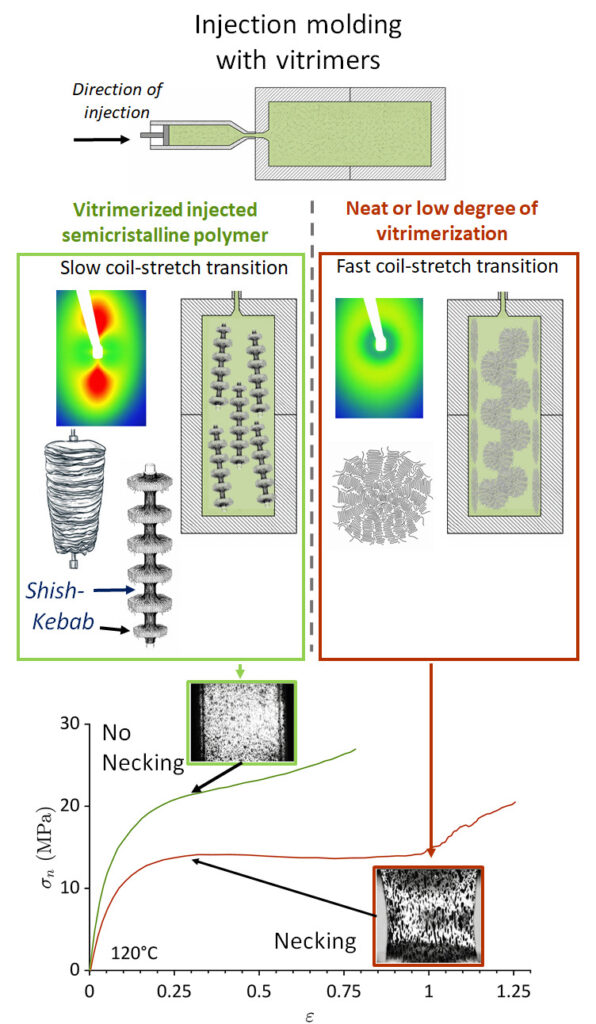
Scientists have identified the source of the mechanical properties of vitrimers, a new generation of recyclable polymers: their performance is linked to how their microstructure forms during processing. These findings pave the way for the design of lighter, stronger, and more durable plastic parts—particularly for transportation, electronics, and industrial equipment—without altering existing manufacturing processes. The study was published in the *Journal of Rheology*.
Vitrimers have been attracting growing interest since their introduction in 2011. Falling somewhere between thermoplastics—which are easily recyclable—and thermosets—known for their dimensional stability—they combine properties that were long considered incompatible. While several studies had already shown that certain vitrimers could exhibit improved mechanical performance, the mechanisms underlying this enhancement remained poorly understood until now.
Researchers have now demonstrated that this enhancement originates not from the solid material itself, but from the way its microstructure forms during processing. The dynamic covalent bonds characteristic of vitrimers do not directly improve the polymer’s cohesion in the solid state.
Instead, they alter the behavior of the molten polymer during injection, allowing the orientation of the polymer chains to be maintained until they crystallize.